
Wedding Band FAQ
Every Question,
Answered Honestly
47 straight answers about hiring a live wedding band in NYC — in the order you'll actually ask them.
Check your dateWedding Band FAQ — Every Question, Answered Honestly
0047 straight answers about hiring a live wedding band in NYC — in the order you'll actually ask them.
Hiring a live band is one of the biggest decisions you'll make for your wedding, and most of the answers online are either vague or quietly trying to sell you something. This page is different. We've gathered the 47 questions couples and planners actually ask us — from "should we even get a band instead of a DJ?" all the way through "we've booked, so what happens next?" — and answered each one the way we'd answer a friend. The questions are grouped in the order they tend to occur to you, so you can start at the top if you're just beginning, or jump to the section that matches where you are. Where a question deserves its own deep dive, we link to the full guide. Everything else is answered right here.
Answered honestly
Sometimes a DJ is the better call. When it is, we say so.
In your order
Grouped by when each question occurs to you, not by our services.
Including the hard ones
The bait-and-switch question and the sick-musician question, answered without flinching.
Getting Started — The First Questions
01What's the actual difference between a wedding DJ and a live band?
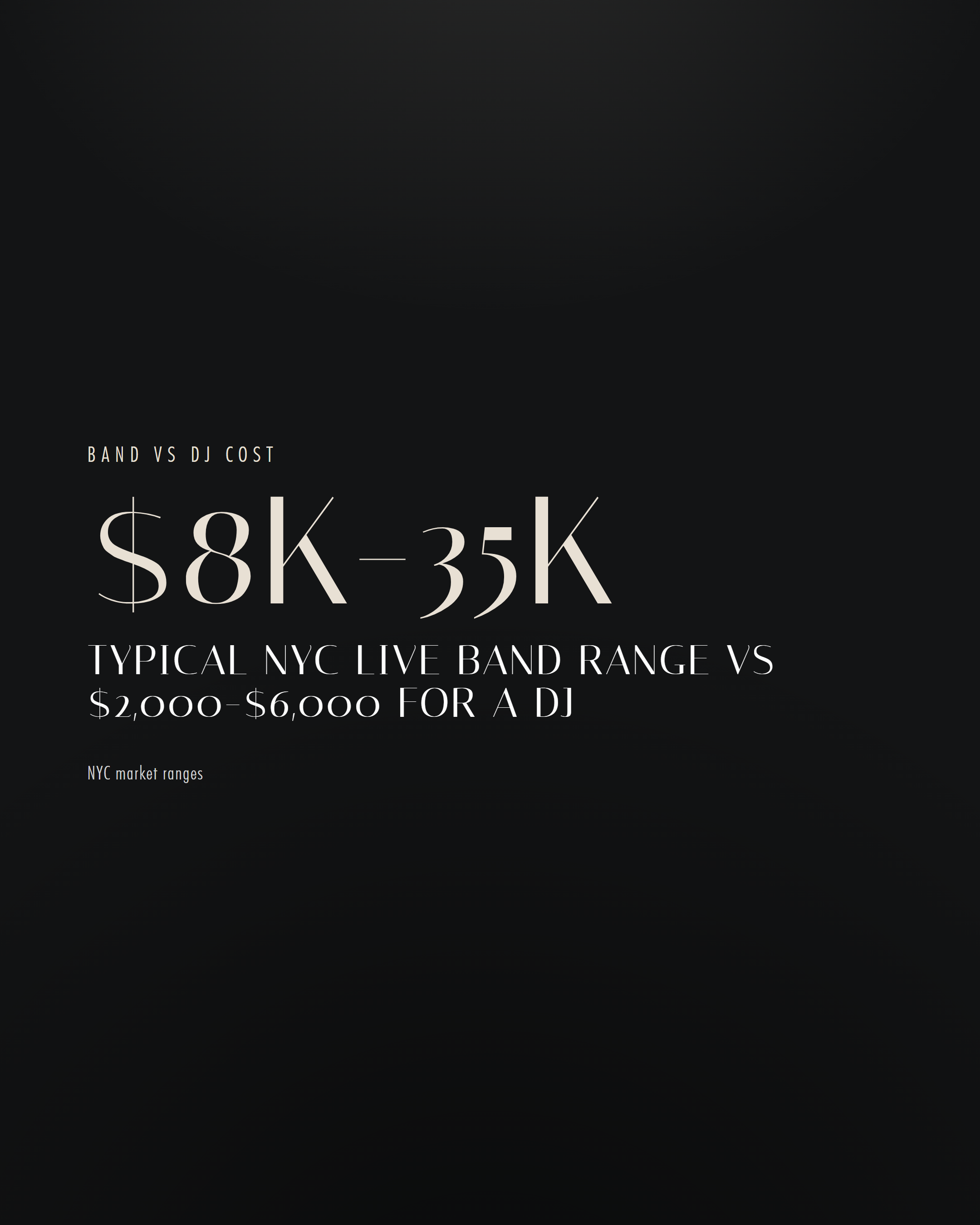
A DJ plays recordings; a live band performs the music in the room in real time. The experience differs at a fundamental level — not better, different. A DJ maintains continuous, curated sound through the speakers. A band creates music in front of your guests, responds to the floor, and gives the room a visual focal point. The cost gap in NYC is real — a DJ typically runs $2,000–$6,000, well below most live bands. See full guide →
Does anyone actually dance more at a live band wedding?
In our experience, yes — consistently. Live music creates a permission structure that gets self-described non-dancers onto the floor. Watching something happen and hearing music being made in real time reduces the self-consciousness of joining in. We've seen people insist at dinner that they weren't going to dance and end up closing out the floor. A DJ can fill a dance floor too, especially with the right crowd — but a band tends to activate crowds that wouldn't otherwise move.
Can a live band actually play the songs I like?
Yes — and it's the most common misconception in this decision. Our catalog runs 200+ songs spanning Motown, soul, funk, R&B, pop, rock, jazz, Latin, and current releases. For songs that aren't in the catalog, we run a custom-learn process for the requests that matter most. What's true is that a band plays its own arrangement of a song rather than the exact studio recording — so a track built around specific production may land differently live. The question worth asking is whether the original recording matters to you, or the song does. Most of the time, the live version is the more powerful one.
Do I need a wedding band if I'm having a small wedding?
There's no minimum guest count for great live music. Some of the best nights we've played were for 50 people in a beautiful room — the energy is more concentrated, not less. The economics shift with smaller events (a six-piece at an 80-person wedding is a different cost-per-head than at a 200-person wedding), and we size the lineup to fit both the room and the budget. If you're planning a smaller, more intimate event, reach out directly and we'll tell you what makes sense.
What does a wedding band actually do at a reception?
The band anchors every moment of the night. A typical flow: ceremony (string trio or acoustic set while guests arrive), cocktail hour (jazz or pop standards while guests mingle), dinner (ambient but present — keeping the room warm without overwhelming conversation), first dance and parent dances (live versions of the songs you chose, learned specifically for your wedding), then open dancing through the end of the night. The band also handles all MC duties — introductions, toasts, transitions — so there's no separate hire for a master of ceremonies.
Can a live band do corporate events, not just weddings?
Yes — we perform at galas, brand activations, holiday parties, award ceremonies, and corporate dinners year-round. Corporate events have different requirements than weddings: pacing, repertoire, and the MC role all change when the audience is a professional group rather than a couple's family and friends. We've been doing both long enough to know the difference. See full guide →
My fiancé wants a DJ. How do I get them to consider a band?
Get them in the room with a live band before the decision is made. It's one of the most common conversations we have, and what wins a skeptic over usually isn't a comparison document — it's the experience. Couples come, watch the band perform, and the decision gets easier because they can feel the difference. What we hear most often from skeptical partners is that the video demo didn't do it, being in the room did. If your partner is on the fence, look through recent events and then check availability before you decide either way.
Is it too late to book a wedding band six months out?
Six months out is tight in NYC, but it's not over. Friday, Sunday, and off-peak dates still have real options; peak Saturdays are the hard case. The most important move is to ask bands directly rather than checking listing-site calendars, which lag real availability by weeks. See full guide →
What's the first thing I should do when thinking about live wedding music?
Lock your venue and date first. Music is built around the room — the size, acoustics, stage space, and noise limits all shape what's possible. Once your date is confirmed, start band inquiries immediately for peak Saturdays; for off-peak dates and Fridays/Sundays, you have a little more runway. The sequence after venue lock: band inquiry → availability check → courtesy hold → deposit to confirm.
Weighing the Options — Cost and Value
02How much does a live wedding band cost in NYC?
Most NYC live wedding bands fall in a market range of about $8,000 to $35,000, driven by band size, hours, your date, and production level. Trios and quartets start lower, around $4,000 to $9,000; a twelve-piece show band with full production sits at the top. These are typical NYC market ranges, not a Great Family Artists price list. See full guide →
Is a live band worth the extra cost over a DJ?
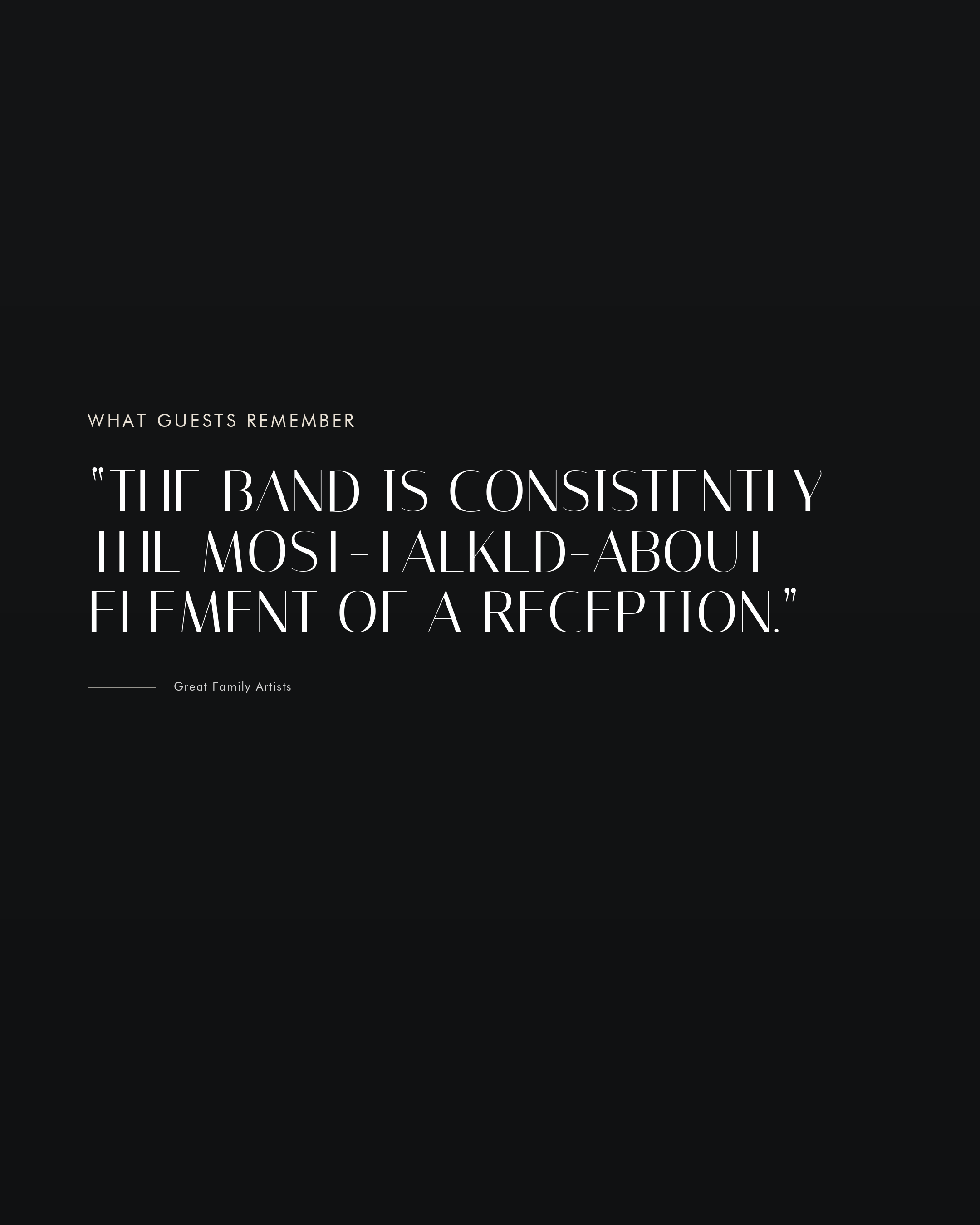
The band is the one vendor your guests talk about at the next five weddings they attend. That's not a marketing line — it's what clients tell us when they refer their friends. Whether it's worth the gap over a DJ depends on what you want your guests to feel and remember. For couples who prioritize the experience of the night above the line items, it is. For couples where the entertainment budget genuinely doesn't reach band pricing without stretching, a great DJ is the right call — and we'd say so to your face.
How many people are in a typical wedding band?
Anywhere from a four-piece to a twelve-piece, depending on the sound you want and the space you're working with. A four-piece (lead vocals, guitar, bass, drums) covers the essentials and fits almost any venue. A seven- or eight-piece adds keyboards and horns, which changes the energy and range significantly. Ten to twelve pieces creates the full orchestra feel that works best in large ballrooms. The size affects the price, the footprint, and the acoustic presence in the room.
Should I allocate more of my wedding budget to the band?
Most wedding planners suggest 8 to 12% of the total wedding budget on entertainment if music matters to you. What actually drives the answer is what you want guests to feel: if the energy of the night is the thing you're buying the wedding for, the band is where the money goes, and couples who treat it as the centerpiece often allocate more. If the meal, the florals, or the photography are the priority, allocate accordingly.
What does a wedding band package actually include?
A complete package covers the full band for ceremony and reception, a professional sound system scaled to the venue, MC duties throughout the night, ceremony music, cocktail-hour coverage, dinner music, first dance and parent dances learned specifically for your wedding, and break playlists during set changes so there's never silence. Ceremony music is typically a separate configuration — a string trio or acoustic duo. What varies between packages: overtime rates after the contracted hours, specific add-ons like lighting, and additional ensembles beyond the core band.
Can I afford a live band on a tighter budget?
Yes — but not by cutting corners on the band itself. Options on tighter budgets: a smaller lineup (four or five pieces instead of eight), an off-peak date or day of week (Fridays and Sundays are often less expensive than Saturdays), and direct booking instead of agency booking (which avoids the 15–30% agency markup). What doesn't work is a band that quotes below the real range for the market — the quality gap shows up at reception time.
What's cheaper — a wedding band or a DJ?
A DJ is almost always less expensive. In NYC, a professional wedding DJ typically runs $2,000–$6,000; a professional live band falls in a market range of roughly $8,000–$35,000. The real question isn't the price gap itself but what the difference buys you in the experience guests have and remember. See full guide →
How much does entertainment cost for a corporate gala in NYC?
A five- to seven-piece band for a corporate dinner or cocktail hour typically runs $8,000–$18,000+, depending on hours, event size, and production requirements. Corporate and gala bookings price differently than weddings. Full gala production — which can include a larger band, MC, AV coordination, and a custom setlist for the event theme — runs higher. For a specific estimate, reach out directly with your event details.
What's the difference between booking through an agency and booking a band directly?
A third-party booking agency or platform sits between you and the band, often adding a 15–30% markup to the band's base price. They manage the calendar and handle the contract on the band's behalf. What you often don't know: the musicians in the demo video may not be the ones who show up for your wedding — third-party platforms frequently book different rosters under the same band name. Great Family Artists is an artist-run, direct-managed roster, so you get direct planning communication and can confirm exactly who will be at your event.
What should a corporate event entertainment proposal include?
A proper proposal includes the exact musicians and their credits, the set structure and timeline, technical requirements (stage, power, sound), MC scope and run-of-show involvement, deposit and payment terms, and cancellation and substitution terms. If a proposal doesn't include who specifically will perform, ask before you sign.
Comparing Bands — How to Choose
03What questions should I ask a wedding band before I book?
Five questions separate a great band from a risk: (1) Are the musicians in your video the ones who'll be at my wedding? (2) How do you handle substitutions if a musician is unavailable? (3) What's your experience at my specific venue? (4) What does the learning process look like for our first dance and must-play songs? (5) What does the contract specify about setup time, breaks, and overtime? See full guide →
How do I know the musicians in the band's video are the ones who'll actually show up?
Ask directly: "Are the people in your demo video the same people who'll be at my wedding?" Many booking agencies cannot answer yes — they book different rosters under the same band name, and the demo is a marketing asset, not a commitment. We can answer yes, and we specify it in the contract. If a band hedges on this question, it's the most important thing to resolve before you sign.
Can we see a wedding band perform live before booking?
You can, and you should. We host showcase events where couples watch the band perform in a real venue context — not a rehearsal, an actual performance. Seeing a band live settles questions no demo video or quote sheet can. If we don't have a showcase scheduled in your planning window, ask about private showcase options. The investment in seeing us before booking is worth it, and we'd rather you come watch than book without having done it.
How do we test whether the band can handle our favorite songs?
Share your song list and request something live. Two parts: first, send us your list and we'll tell you directly which songs are in the catalog, which we'd learn, and which may be outside the scope. Second, come to a showcase and request something — it's a far better test than watching a polished demo. A band that handles a live request gracefully is a band that handles surprises at your reception gracefully.
How do I compare different wedding bands in NYC?
Five criteria actually predict a great performance, and none of them are the demo clip: (1) Fixed vs. rotating roster — are these the same musicians every time? (2) Direct booking vs. agency — who do you actually have access to? (3) Experience at your specific venue or venue type — have they worked the space? (4) Reputation in reviews — not the star count, the specific stories people tell. (5) Response quality in your first communication — how a band handles the inquiry is how they'll handle the rest of the relationship. See full guide →
How far in advance should I book a wedding band in NYC?
12–18 months for a top-tier band on a peak Saturday in spring or fall; 6–9 months is realistic for Fridays, Sundays, and off-peak dates. The more specific you are about which band and which date, the earlier you need to move. See full guide →
What do I do if my first-choice band is unavailable for my date?
Don't panic — it's almost always solvable. Three options, in order: (1) Check whether adjacent dates work and whether the venue has flexibility. (2) Ask the band for a waitlist placement — cancellations happen, including at the six-month mark. (3) Ask who the band's closest peers are — a good band knows the other strong bands in the market and will tell you. A date that's gone for your first choice isn't the end of finding great live music for your wedding.
What makes a great MC at a corporate event?
A great MC knows the run-of-show before the event, not at it. The MC is why a room pulls together or feels disjointed. What separates effortless from awkward: they handle transitions without dead air, they read the room (when to add energy, when to pull back), and they're comfortable with the unexpected, because something unexpected happens at every event. Our MC duties are handled by the band's lead performer, who is performing the whole night — not parachuting in for announcements.
What's the difference between a 6-piece and a 10-piece wedding band?
More musicians means more sound, more range, and more energy — and more cost and more stage space. A six-piece (lead vocals, guitar, keys, bass, drums, and a horn or second vocalist) is versatile and fits almost any venue. A ten-piece adds depth in the horn section, more vocal range, and the ability to fill a larger room with greater sonic presence. For most weddings, a six- to eight-piece is the right answer; a ten- or twelve-piece is for large ballrooms or couples who want the full orchestral feel.
Are your reviews on The Knot and WeddingWire real?
Yes — and you can check sources no one moderates, too. Our reviews on WeddingWire are from verified couples who booked us, and The Knot listings are the same. But the reviews that carry the most weight are the ones in places GFA didn't control: conversations in wedding Facebook groups, Reddit threads, planner-to-planner referrals, and the direct notes couples sent us afterward. For the unmoderated version, search our name on Reddit and in any NYC wedding planning community. Read client reviews →
Before You Sign — Contracts, Deposits, and Contingencies
04What happens if a musician in the band gets sick the day of my wedding?
The moment we know, we activate our substitution network. It happens — not often, but it does. We maintain a roster of vetted, rehearsed musicians who know our set and our approach, and the substitute is the same tier and caliber as the person they're replacing. The contract specifies our substitution terms, and we've never left a couple without live music. See full guide →
What does a wedding band contract need to include?
Eight things: (1) the specific named musicians performing, (2) date, venue, and exact hours, (3) set structure and total performance time, (4) what's included — sound, MC, ceremony music, break music, (5) substitution terms if a musician is unavailable, (6) deposit amount and balance due date, (7) cancellation policy with the sliding-scale clause, and (8) the overtime rate if the event runs long. If any of these are missing or vague, ask before you sign. See full guide →
How much deposit is normal when booking a wedding band?
Standard is 25–50% of the total to hold the date, with the balance due 30–60 days before the wedding. Below 25% is unusual and may signal a band that's overextended on bookings. Above 50% upfront is aggressive and worth asking about. The deposit is what takes your date off the calendar — without it, no courtesy hold lasts indefinitely. See full guide →
Can we customize the playlist and setlist with a wedding band?
Yes — it's one of our favorite parts of the process. A few months before your wedding, you'll fill out our Music Curation Form — a structured walkthrough of every moment of the night, from cocktail hour to last dance. You choose your must-play and do-not-play lists, your first dance and parent dance songs, and any cultural or traditional music you want included. We review it, confirm what's in the catalog, and tell you what we'll learn specifically for your event. See full guide →
We want to book you but aren't sure of our date yet. Can you hold it?
We do a 48–72 hour courtesy hold while you confirm your venue or finish the decision. After that window, a deposit is what takes the date off the calendar. The hold exists so you're not forced to choose between "not ready to commit" and "might lose the date." Tell us your date, we'll check availability in real time, and if it's open we'll hold it while you confirm your venue.
We're having a hybrid in-person/virtual gala. Can a live band work in that format?
Yes — we've broadcast in-room energy to virtual audiences and know what the production setup requires. The key differences from a standard event: audio goes through both the room PA and the broadcast mix simultaneously (different mixes, often different engineers), the camera position matters for the virtual audience's visual experience, and the pacing and MC script need to account for the chat/reaction lag on the virtual side. We work with your production team on the technical rider to get both right.
Does the band need a special sound setup for our venue?
It depends on the room. The variables: square footage, ceiling height, ambient noise, and any venue-imposed volume limits. We do a technical walk-through with every new venue before the event and scale the sound system to the space — you don't need to manage this, but we do need the venue specs and contact. For high-ceiling rooms, reflective surfaces, or outdoor events, the setup is more involved.
What if the venue has a noise ordinance or volume limit?
Volume limits don't kill the energy — they change how you build and manage it. NYC venues have stricter sound limits than almost anywhere else in the country, and we know most of the rooms. The practical difference: our sound engineer accounts for the decibel ceiling in the mix, we position speakers to direct sound toward the dance floor rather than the walls, and we adjust set pacing to keep the floor active within the constraints. We've played rooms with hard volume limits and still had the floor packed all night. See full guide →
What information do you need from us before the wedding?
Venue specs and contact, your confirmed timeline, your Music Curation Form, day-of contact information, and any specific moments we need to know about. We use a structured advance process — the same framework tour managers use, adapted for private events. The confirmed timeline covers ceremony start, cocktail hour, dinner, first dance, and end time; the special moments include surprise songs, dedications, and cultural traditions. We reach out at specific points in the process; you won't need to chase us.
What's your cancellation policy if something changes on your end?
Our cancellation policy uses a sliding-scale clause: the further out you cancel, the lower the fee. Cancellations more than six months before the event return most of the deposit; within six months the retained amount increases; within 30 days the full contracted amount applies. The policy is documented in the contract before you sign, and it's designed to protect both sides — we lose the date when you cancel, and you're protected from a cliff-edge policy that punishes you for circumstances outside your control.
After You Book — What Happens Next
05Now that we've booked the band, what happens next?
You'll hear from us at three points before the wedding. First, about six months out: we send the Music Curation Form and start the setlist process. Second, about 30–60 days out: we confirm the venue logistics, timeline, and any last-minute song changes. Third, a week before: a final run-through with the lead performers, confirming the timeline and any last-day specifics. In between, you have direct contact with us — not an agency — so any question gets a direct answer.
How do we get the band our must-play songs and do-not-play list?
Through the Music Curation Form, which walks you through every moment of the night systematically. You'll input your first dance, parent dances, ceremony music, cocktail hour preferences, songs you definitely want during open dancing, and a do-not-play list. We process the form, cross-reference with the catalog, and come back to you with confirmation and any notes on songs we'd learn. The form is comprehensive enough that we rarely need to follow up with clarifying questions. See full guide →
What should our reception timeline look like around the band?
The timeline is built around two anchors: the first dance and the peak energy moment you want to create. The peak moment is usually mid-reception, when dinner is winding down and the floor opens up. Working backward and forward from those two points, we build a schedule that covers cocktail hour, dinner sets, formalities, and open dancing without dead time. See full guide →
Will my partner like it if they're nervous about a live band?
We hear this from skeptical partners all the time. The conversation usually changes when they see real musicians reading a room, not just a demo clip. If your partner is still unsure, look through recent events together and ask us what format fits your crowd. The demo helps; the room energy is what usually makes the decision click.
How does the band handle MC duties for intros and toasts?
The MC role is woven into our performance, not a separate hire. Our lead performer handles introductions, announces the first dance and parent dances, cues the toasts at the right moments, and manages the flow between formalities and music without dead air. We coordinate with your coordinator or planner in advance on the exact run-of-show, so every introduction lands on cue and every toast has its moment.
What if we change our mind on a song after submitting the list?
Totally normal — changes before the 30-day mark are usually easy to accommodate. The Music Curation Form has a revision window. After the 30-day mark, the band has already begun rehearsing your specific setlist, so changes that require learning a new song may not be possible on short notice. Changes to song order, emphasis, or selections from the existing catalog are almost always fine right up to the event.
We need to move our wedding date. What happens with the band booking?
It depends on our calendar and how much notice we have. For moves with more than six months of lead time, we can often transfer the booking to the new date if we're available. For shorter-notice moves, we work with couples on a case-by-case basis — availability is the binding constraint, and we're honest about it when the new date is already taken. The contract has specific terms for date changes; review those first, then reach out directly.
What's the best way to get the most out of a live band at a corporate gala?
Treat the band as a tool for your event's actual objective, not a background feature. If the goal is networking, structure the set so there are high-energy moments that bring people together on the floor and quieter moments that create space for conversation. If the goal is celebration, anchor the peak set to a specific moment in the program — an award, a milestone, a product announcement — so the band amplifies the emotional beat the event was building toward. See full guide →
Choose the market behind your question
The honest answer changes when the room changes. Start with all locations, then branch into the city, mountain, destination, or gala page that matches the event you are actually planning.
Locations
Colorado, New York, destination events, Miami and Texas in one connected map.
NYCNYC Weddings
Manhattan, Brooklyn, Hudson Valley and tri-state wedding-band questions.
ColoradoColorado Weddings
Denver, Boulder, Vail, high-country logistics and mountain venue planning.
New MarketMiami Weddings
South Florida launch dates with destination-ready production and proof from home markets.
New MarketTexas Weddings
Dallas, Houston, Austin and Hill Country dates with the same touring operation.
CorporateNYC Galas
Run-of-show, MC, production and room-energy questions for gala buyers.
Still have a question?
If it's not here, it's the kind we like to answer directly.
If your question isn't here, it's usually specific to your venue, your date, or your guest list — and those are the questions we most like to answer directly. Reach out with your date and we'll tell you honestly whether we're available, what it would look like, and what it would cost. We can place a short courtesy hold while you decide, and you're welcome to see the musicians, formats, and rooms before you commit to anything.
See recent events · Check availability